
Sons in the Son
Reflections on the Letham–Tipton Critique of David Garner’s Book “Sons in the Son.”

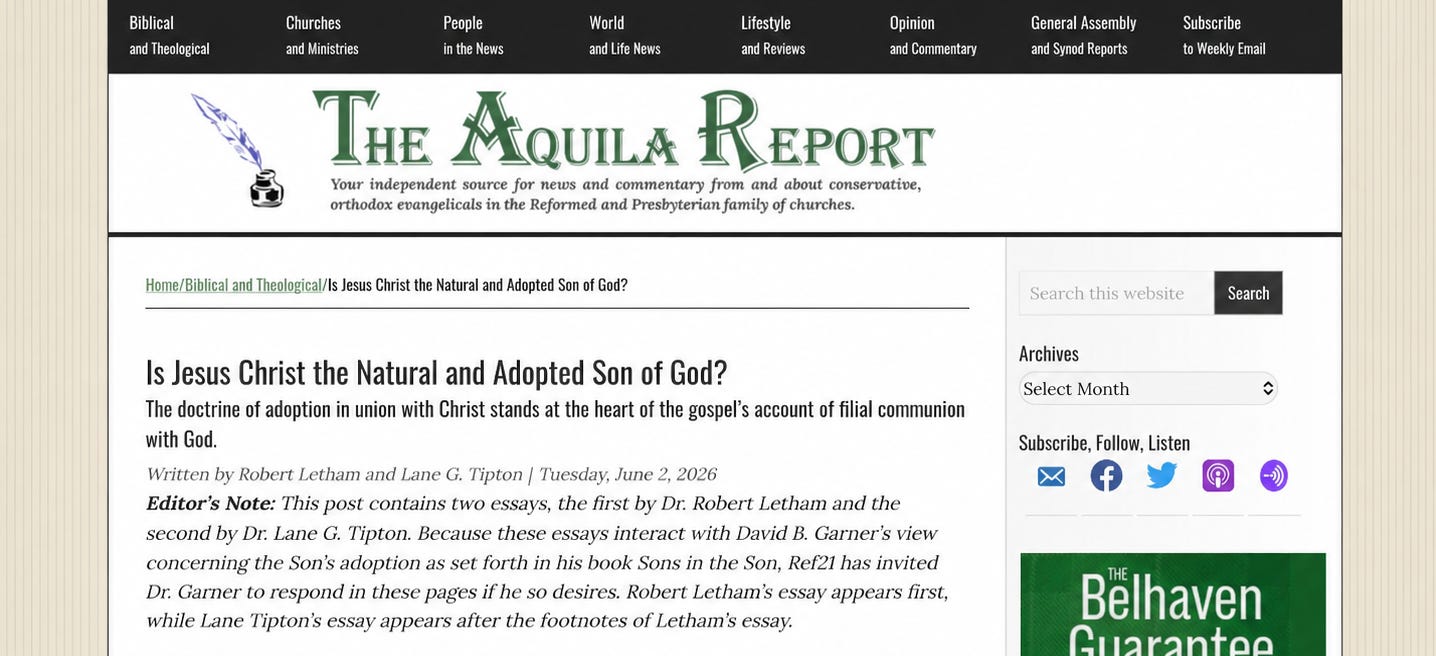
This article from The Aquila Report is a critique of a book written by David Garner called Sons in the Son, which was published in 2016. I have never read the book myself, but I have ordered a copy due in part to the many endorsements it received. The book has a foreword by Sinclair Ferguson, and the endorsements included J. I. Packer, Joel Beeke, Richard B. Gaffin Jr., Harry L. Reeder III, and Guy Prentiss Waters.
This critique by Dr. Robert Letham and Dr. Lane Tipton is highly academic and employs precise theological terminology. I found myself having to consult definitions simply to work through it.
The Letham–Tipton article does an excellent job defending classical Chalcedonian Christology, and I am thankful that the church has such able defenders of orthodoxy who know the proper terminology to discuss these matters.1 There was a time when these categories were widely understood throughout the church. Today, however, much of that vocabulary has been lost, making discussions like this difficult for ordinary readers to follow.2
I have included a dictionary of the key terms in an appendix. In several places, the dictionary also functions as a running commentary on the article itself. As I worked through the discussion, I found myself having to look up many of these terms just to ensure I understood what was being argued. You can find the full article at The Aquila Report here. 3
If I had to summarize the article’s main point in plain English, it would be this:
Dr. Robert Letham argues that Christ cannot be an adopted Son because adoption belongs to persons, not natures. If Christ were adopted, either the eternal Son would enter a new filial relationship with the Father (threatening divine immutability) or Christ’s humanity would function as a separate personal subject (tending toward Nestorianism). Thus, Jesus Christ is eternally the natural Son of God and never becomes an adopted Son.
Dr. Lane Tipton puts it this way: Moreover, the messianic sonship of Jesus distinguishes the Redeemer from the redeemed; it at no point subsumes their identities under a single filial category. Christ is the incarnate Mediator, the anointed Son sent by the Father to accomplish redemption for those who are adopted in him. His filial identity is therefore not derivative or redemptive, but natural and eternal. The mediatorial office rests entirely upon his identity as the eternal Son. Precisely because he is the natural Son, he can communicate adoptive sonship to others through union with himself. The resurrection, therefore, does not transform Christ into an adopted son alongside believers; rather, it publicly declares and enthrones the incarnate Son as the exalted Messiah who secures and bestows adoptive sonship upon his people.
Given that this article in The Aquila Report has ably defended the Son’s uniqueness, I want to examine the question from the perspective of the “sons.” What does it mean for believers to participate in union with Christ? How do the Chalcedonian boundaries frame that discussion? If Christ is the natural Son and we are adopted sons, what exactly do we participate in, and what distinctions must remain in place if those boundaries are to be preserved?4
Ontological Union
This is probably the first place to start when talking about the nature of our participation in the body of Christ. From the discussion in the Letham–Tipton article it should be clear that the incarnation is unique. Before the incarnation the Son was asarkos—without flesh. After the incarnation he was ensarkos—the Word made flesh. He took to himself a true human nature, but he did not absorb that human nature into the divine nature. Chalcedon is the operating grammar here: one person, two natures, without confusion, without change, without division, and without separation. This hypostatic union is unique and unrepeatable.
How then do the “sons” participate in Christ? They do not become one with Christ’s human nature. They are adopted sons, not natural sons. The sons participate in Christ, but they do not become part of Christ’s hypostatic union or personal identity. They remain human persons united to him by the Holy Spirit.
This boundary is important. Whatever union with Christ means, it cannot mean that believers are physically incorporated into Christ’s human nature or absorbed into his personal identity. The church has often used very strong language about participation, communion, deification, and union with Christ, but no orthodox tradition teaches that believers become part of the hypostatic union itself. The incarnation happened once. The Son became man. We do not become part of the God-man.
The Chalcedonian boundary remains in place. Christ remains the natural Son. We remain adopted sons. Whatever participation means, it must preserve that distinction.
Ecumenical Agreement
At this point there is remarkably little disagreement among the major branches of the church. Roman Catholics, Eastern Orthodox, Lutherans, and the Reformed all affirm the uniqueness of the hypostatic union. They may differ somewhat in how they describe the participation of the sons, but they do not teach that believers become part of Christ’s hypostasis.
Sometimes theologians speak of the church as an extension of Christ’s presence in the world or even use language that sounds incarnational. However, such language is not meant literally. The church is not a continuation of the incarnation, nor are believers incorporated into Christ’s hypostatic union. The incarnation happened once and belongs uniquely to the eternal Son. Whatever participation, communion, union, or deification means, it must preserve the distinction between the natural Son and adopted sons.
In that sense, Chalcedon functions as a guardrail for the entire discussion. The real debate is not whether believers participate in Christ, but how they participate in Christ while remaining within those boundaries.
If believers do not participate in Christ by becoming part of His hypostatic union, then how do they participate? The New Testament repeatedly answers: by union with Christ through the Holy Spirit. We remain distinct human persons, yet we truly share in His life, His inheritance, His kingdom, and the adoptive sonship that He has secured for us by grace. The precise nature of that participation has been described in various ways throughout church history and deserves further examination. That question will be my focus in future articles as time permits.5
The Sons of David and the Blood Royal
This article in The Aquila Report has certainly sparked my interest in a further study of the doctrine of adoption. The highly technical nature of the article has helped me grow in my understanding of Jesus Christ. I needed a refresher on Christology. The article did something even more—it made me want to know more about our adoption in Christ and what that means on a day-to-day basis. I look forward to reading this book, although with caution about the Christological boundaries.6
When I see all the names endorsing this book and read the preface written by David Garner himself, I see a theologian writing within a Westminster tradition shaped by Vos and Murray. He seems to be trying to bring the doctrine of adoption to a more central place in our understanding of union with Christ. Calvin said as much—all our benefits flow from our union with Christ.
If we are all adopted sons, then we are all part of the blood royal. We are royalty with Him—not by physical descent, but by our union with Christ, the true and natural Son. Our brotherhood in Christ is more real than any other human relationship. It is beyond words. If this is so, we must love one another as brothers and treat each other with the respect and dignity due to sons in the Son. True royalty behaves a certain way.
Having carefully read the Letham–Tipton critique, I do not see any personal attacks or any attempt to misrepresent David Garner. Rather, I see a band of royal sons discussing the Royal Son. If there is one thing sons ought to manifest, it is love for one another. Theological disagreements may be necessary, but they should always be conducted within the bonds of brotherly affection. As our Lord taught, “By this all people will know that you are my disciples, if you have love for one another” (John 13:35).
At the end of all this, my hope is that we will gain a clearer and deeper understanding of Christ and His salvation. The work of these pastor-theologians is an invaluable gift to the church. Most of us see only the finished product—the books, articles, lectures, and sermons. We do not see the years spent learning languages, reading difficult texts, wrestling with theological questions, and carefully weighing words. Much of that labor remains hidden, yet the whole church benefits from it. 7
These men are what Calvin might have called doctors of the church. Not that this is a distinct ecclesiastical office, but there are those whose calling is so specialized that years of study and scholarship are necessary to defend and clarify the truth. The body of Christ needs all its members working together, each according to the gifts God has given.
I thank God for this great cloud of witnesses—past and present—who, by His grace, continue to help the church grow in the knowledge of Christ as we press onward toward the consummation of all things.
Amen.
Appendix: A Short Christological Dictionary for the Rest of Us
The article by Robert Letham and Lane Tipton uses a number of technical theological terms that may be unfamiliar to many readers. The following definitions are simplified and intended to help orient non-specialists including myself. :)
Accident – A term from Aristotelian philosophy referring to a non-essential property of a thing. Classical theologians often used the distinction between substance and accidents in theological discussions, including explanations of the Lord’s Supper. While influential in medieval theology, the concept is a philosophical category rather than a biblical term.
Adoption – The gracious act by which believers are received into God’s family as sons and daughters through Christ.
Adoptionism – The heresy that Jesus became God’s Son by adoption, reward, or exaltation rather than being the eternal Son by nature. In the Letham–Tipton critique, the concern is that such language can imply two sons: the eternal Son of God and a human son who receives sonship. Classical Christology insists that there is only one Son—the eternal Son—who assumed human nature and remained the same divine person throughout His incarnation, death, resurrection, and exaltation.
Anhypostasia – The teaching that Christ did not assume an already-existing human person. He assumed a true human nature.
Analogia Entis (Analogy of Being) – The view that language about God is generally analogical rather than univocal or equivocal. Terms such as Father, Son, good, and wise are not used in exactly the same sense of God and creatures (univocal), nor in completely different senses (equivocal). Rather, there is a real likeness grounded in creation and redemption, while God remains the Creator and we remain creatures. The doctrine seeks to preserve both meaningful knowledge of God and the Creator-creature distinction.
Arianism – The heresy that the Son was created by God and is not fully divine.
Asarkos – “The Word without flesh.” The eternal Son considered apart from the incarnation.
Asymmetry – A relationship that is not identical in both directions. Christ is Son by nature; believers are sons by adoption. The relationship is real but not symmetrical.
Chalcedon – The Council of Chalcedon (AD 451), which affirmed that Christ is one person in two natures, fully God and fully man.
Christology – The branch of theology that studies the person and work of Jesus Christ.
Communicatio Idiomatum – Latin for “communication of properties.” Because Christ is one person with two natures, Scripture can attribute to the one person things belonging to either nature. Thus God can be said to shed His blood (Acts 20:28), not because the divine nature bleeds, but because the person who shed His blood is God the Son. In the Letham–Tipton discussion, the doctrine chiefly safeguards the truth that the same person who was born of Mary is the eternal Son of God.
Cyril of Alexandria (c. 376–444) – Patriarch of Alexandria and chief spokesman for the Alexandrian Christological tradition. He defended the unity of Christ’s person against Nestorius, insisting that the one born of Mary is the eternal Son of God incarnate. His theology strongly influenced the later definition of Chalcedon (451). Major works include On the Unity of Christ, Commentary on John, and his letters to Nestorius.
Enhypostasia – The teaching that Christ’s human nature exists personally in the eternal Son. It is not a separate human person.
Ensarkos – “The Word in flesh.” The eternal Son after becoming incarnate.
Eternal Generation – The doctrine that the Son is eternally begotten of the Father. This is not something that happened before creation or at a moment in time. Rather, it describes the Son’s eternal personal relation to the Father within the Trinity. Classical theology refers to eternal generation as the Son’s personal property or relation of origin. It distinguishes the Son from the Father while affirming that both share the same divine nature and are equally God.
Exaltation – Christ’s resurrection, ascension, heavenly reign, and future glory.
Filiation – Sonship; the relationship of a son to a father. In Trinitarian theology, the eternal filiation of Christ refers to His eternal Sonship as the only-begotten Son of the Father. In discussions of adoption, theologians often distinguish Christ’s natural filiation from the believer’s adoptive filiation.
Historia Salutis – “History of salvation.” The events by which Christ accomplished redemption in history.
Hypostasis – A person or personal subject. In Christology, the one hypostasis is the eternal Son.
Hypostatic Union – The union of two natures, divine and human, in the one person of Jesus Christ.
Immanent Trinity – God as he eternally exists in himself, apart from creation.
Incarnandus – Latin for “the One who is to become incarnate.” Refers to the eternal Son considered in relation to the coming incarnation.
Incarnation – The act by which the eternal Son took a true human nature and became man.
Investiture – Formal installation into an office or authority. Letham and Tipton argue that the resurrection is Christ’s investiture as the exalted Messiah, not his adoption.
Letham, Robert (1947– ) – Reformed theologian, pastor, and historian of doctrine. He has written extensively on the Trinity, Christology, the ecumenical councils, and Reformed theology. In this debate, Letham argues from the historic Christological tradition that Christ is eternally the natural Son of God and cannot be described as an adopted Son without creating serious problems for the doctrines of the Trinity, divine immutability, and the person of Christ.
Logos – Greek for “Word.” A title used by John for the eternal Son of God.
Mediator – One who stands between God and man. Jesus Christ is the sole mediator between God and humanity.
Murray, John (1898–1975) – Reformed theologian and professor at Westminster Theological Seminary. Murray’s work on union with Christ profoundly influenced modern Reformed theology. He emphasized that all the benefits of salvation—justification, adoption, sanctification, and glorification—flow from union with Christ. His theology forms part of the broader Westminster tradition in which David Garner’s work is situated.
Nature – What something is. Christ possesses both a divine nature and a human nature.
Natural Sonship – Christ’s eternal Sonship by nature. He is Son because of who he is, not because of anything granted to him.
Natural Sonship vs. Adoptive Sonship – The central distinction in the article. Christ is Son by nature; believers are sons by adoption.
Nestorianism – The heresy of dividing Christ into two personal subjects, one divine and one human, instead of confessing one person with two natures. The term comes from Nestorius, though many scholars today argue that Nestorius himself may not have taught the position later labeled “Nestorian.” The debate serves as a reminder that when discussing Christology, precise definitions matter. A poorly chosen phrase can easily be misunderstood and make someone sound as though they are saying more—or less—than they actually mean.
Office – A role or task. Christ’s three offices are Prophet, Priest, and King.
Ontological – Relating to what something actually is in its being or essence.
Ordo Salutis – “Order of salvation.” The application of redemption to believers (calling, faith, justification, adoption, sanctification, etc.).
Person – The acting subject. Classical Christology teaches that Christ is one person with two natures.
Predication – Attributing something to a subject. Much of the debate in the article concerns what may properly be predicated of Christ.
Resurrection Vindication – The declaration by God that Christ’s work was accepted and that he is righteous. Tipton argues this is different from the believer’s justification.
Soteriology – The doctrine of salvation.
Subsistence – The concrete existence of a person. Christ’s human nature subsists in the person of the Son.
Tipton, Lane G. – Reformed theologian, minister, and scholar associated with Westminster Seminary California. Deeply influenced by the biblical theology of Geerhardus Vos, Tipton emphasizes the distinction between Christ’s eternal Sonship and His mediatorial office. In this debate, he argues that Christ is not Son because He is Mediator; rather, He is Mediator because He is the eternal Son. Therefore, adoption belongs to redeemed sinners united to Christ and cannot be predicated of Christ Himself.
Vos, Geerhardus (1862–1949) – Often called the father of Reformed Biblical Theology. A professor at Princeton Theological Seminary, Vos emphasized the unfolding history of redemption and the centrality of union with Christ. In the adoption debate, Tipton relies heavily on Vos’s distinction between Christ’s eternal Sonship and His mediatorial office. For Vos, Christ is not Son because He is Mediator; He is Mediator because He is the eternal Son.
I am glad that Reformation21 and The Aquila Report have brought this important discussion into public view for the edification of the church. It is a difficult piece to digest—but sometimes we must do the work required to mature in the faith. We cannot always settle for milk; sometimes we need steak. This article is definitely steak.
One example of the density of the discussion occurs when Letham states that believers are “adopted into the natural Son to share his identical relation to the Father.” As a lay reader, I initially found this statement confusing. Taken by itself, it could appear to blur the distinction between Christ’s natural sonship and our adoptive sonship. Following the footnote trail into Donald Fairbairn’s discussion of Cyril helped clarify the point. Elsewhere, Letham explicitly distinguishes between Christ’s sonship and ours, writing that “our filiation is participated, his is natural.” In other words, believers do not become natural sons. Rather, our adoptive sonship is derived from and dependent upon the natural Son, while remaining distinct from His eternal sonship. I include this example simply to illustrate how academically dense parts of this discussion can be and why the footnotes were an important part of the discussion. Sometimes they were necessary to understand the argument.
https://theaquilareport.com/is-jesus-christ-the-natural-and-adopted-son-of-god/
As a Substack writer, I do not pretend to enter this discussion on equal terms with the scholars involved. I am conscious of my limitations and want to acknowledge them at the outset. At the same time, this discussion belongs to the whole church. The priesthood of all believers means that every Christian has a stake in understanding the faith once delivered to the saints. We are all called to grow in the grace and knowledge of our Lord Jesus Christ. In that respect, the Letham–Tipton article serves the church well. By bringing difficult theological questions into public discussion, it invites the entire body of Christ into the great conversation of the Great Tradition.
I am bi-vocational and have limited time to write. In one sense, writing could easily become a third vocation unless it remains in service to the other two. 😉 I generally write in order to better understand. I do not hold a Ph.D., but I deeply appreciate the work of those who do. The church needs pastors, teachers, and scholars who devote themselves full-time to the careful study and defense of the faith. My own writing is simply what I am able to contribute in the time available to me. If I have misunderstood something or made an error, I welcome correction. I am still learning myself and make no claim to have mastered these subjects.
I find the concerns raised by Dr. Letham and Dr. Tipton significant. Since Ref21 has invited Dr. Garner to respond, I look forward to seeing how the discussion develops and whether some of these concerns can be clarified through further dialogue.
One lesson I have taken from this discussion is the importance of precise theological language. The church’s Christological vocabulary was not developed as an academic exercise but as a safeguard for the gospel itself. Terms such as person, nature, sonship, adoption, and union with Christ carry a long history of careful reflection. If those terms are used loosely, confusion can quickly follow.
Having not yet read Dr. Garner’s book, I am not in a position to evaluate all of his arguments. However, the concerns raised by Dr. Letham and Dr. Tipton are substantial and deserve a careful answer.
My hope is that discussions such as these will encourage both theologians and laypeople to think more deeply about what it means to be sons in the Son. We all have a stake in the answer, for it touches the heart of our identity in Christ and the nature of the salvation He has accomplished for us.